Work Must Not Be Slavery
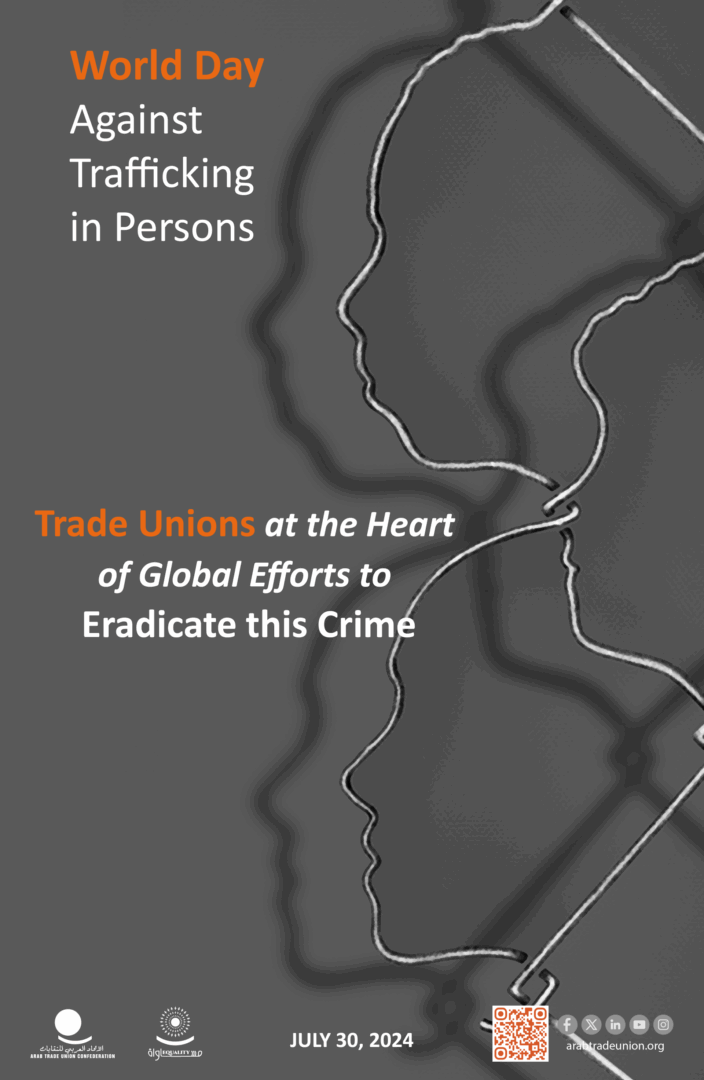
On the occasion of World Day Against Trafficking in Persons – 30 July
Every year on July 30, the world sheds light on one of the most heinous violations of human rights: human trafficking. Despite international efforts and regional legislation, millions of women, men, and children are still exploited daily in conditions unworthy of human dignity—driven by poverty, war, ignorance, or unjust laws.
At the heart of this bleak reality, we find that work itself—meant to be a source of dignity, freedom, and self-fulfillment—has, in many contexts, been transformed into a modern form of slavery. This is unacceptable and unjustifiable.
Forced labour is not work — it is coercion and enslavement
The International Labour Organization defines “forced labour” as any work or service extracted from a person under threat of penalty and performed involuntarily. In our Arab region, manifestations of such exploitation are numerous:
• Sponsorship systems (kafala) that turn migrant workers into “private property” of employers.
• Confiscation of passports and restriction of movement, stripping workers of their freedom and exposing them to blackmail.
• Inhumane working conditions in sectors like agriculture, construction, domestic work, and digital services, without adequate pay, health insurance, or social security.
• Sexual exploitation and trafficking of women and children in conflict zones or during irregular migration.
These are not merely “tough conditions,” as some narratives try to downplay them. They are organized crimes targeting the most vulnerable and subjecting human beings to a market logic devoid of moral value.
Dignity is not a privilege… it is a right for every worker
Work is not a favor granted by anyone. It is a right. Dignity is a right. Freedom at work, fair wages, and protection from violence and exploitation are not luxuries—they are fundamental rights enshrined in all international instruments, from the Universal Declaration of Human Rights to ILO conventions.
But in reality—especially in the absence of trade union organization, labour inspection, and rule of law—market forces run unchecked, and the line between legitimate work and disguised servitude collapses.
Work must not be slavery… and unions are the shield
On this World Day, condemnation is not enough. We must reaffirm that union organization and the right to join an independent and representative trade union are the first lines of defense against exploitation and trafficking.
The trade union movement is not only a voice of protest—it is a collective defense structure, a negotiating mechanism for fair conditions, and a platform to protect victims from silence and exclusion. The more unions are banned, repressed, or marginalized, the more human trafficking flourishes in the shadows.
A call for dignity and justice
Today, in the face of this transnational crime, we need a broad alliance—among trade unions, human rights organizations, states, and every living conscience. We need fair legislation, effective law enforcement, humane migration policies, and political will that resists economic pressure.
Work must not be slavery. The free world cannot accept that any person be forced to work under threat, in degrading conditions, or without pay—or hope.
There will be no just future without decent work, a free union, and a worker protected by law—not enslaved by market dictates.
 Arabic
  English