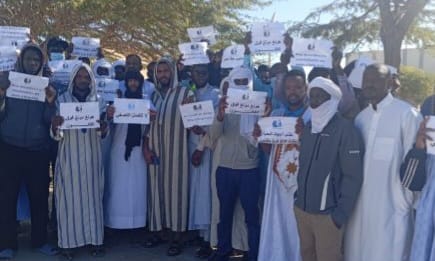
On the morning of Friday, 23 January 2026, the sit-in staged by workers of the Chinese company Poly Hondong in front of the Wilaya headquarters in Nouadhibou was not a routine protest over workplace demands. It was a condensed expression of a deeper imbalance in labour relations within certain foreign investment projects—where the need for jobs intersects with fragile legal protections for workers, and where the state’s capacity to enforce its social sovereignty is put to the test inside enterprises that are supposed to operate on its territory and under its laws.
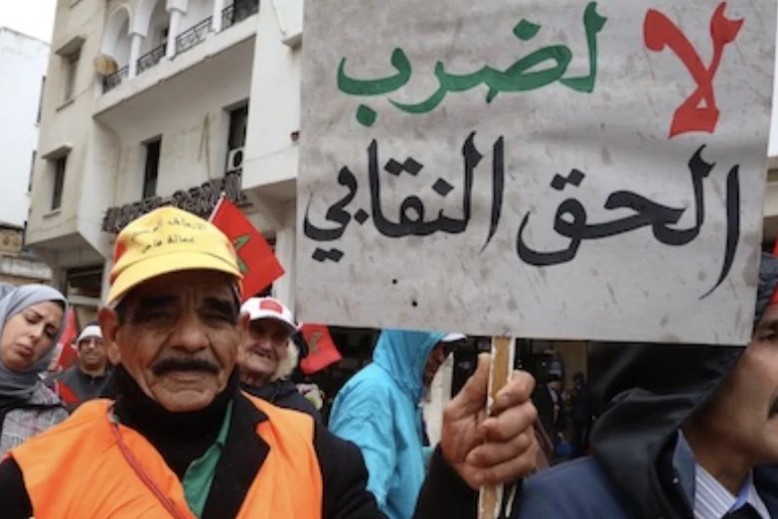
The workers gathered outside the Wilaya did not raise political slogans, nor did they demand anything beyond their basic rights. Their demands, as they expressed them, were simple and clear: an end to arbitrary punitive measures, respect for agreed commitments, and the assurance of a minimum level of dignity in the workplace. Yet the simplicity of these demands did not conceal the depth of the crisis revealed through every testimony and every banner raised that morning.
According to the workers’ accounts, the company’s management applies a strict surveillance regime that goes as far as unjustified punishment. Merely leaving the workplace for a short period—even for humanitarian or health-related reasons—can lead to “questioning” and disciplinary measures that workers consider degrading and unlawful. In an industrial work environment marked by high physical exertion and harsh climatic conditions, such practices become a tool of constant psychological pressure, making workers feel permanently under suspicion rather than engaged in a normal employment relationship.
But the problem does not stop at surveillance and discipline. Workers also speak of a clear breach of previous contractual commitments, most notably the denial of transportation services that the company had pledged to provide. In a city like Nouadhibou, where distances are long and mobility conditions are difficult, transportation is not an additional benefit but a basic requirement to reach the workplace safely and regularly. The withdrawal of this right, from the workers’ perspective, was not merely an administrative decision, but an additional pressure mechanism that places financial and physical burdens on them that they cannot afford to bear.
One of the workers participating in the sit-in summed up the situation with a striking phrase: “We are not rejecting work; we are rejecting being treated as if we have no rights.” This sentence captures the essence of the dispute. The issue is not a refusal of discipline or professional obligations, but a refusal to turn discipline into a tool of repression and investment into a space exempt from national labour rules.
From a broader trade union perspective, this case raises sensitive questions about the nature of certain foreign investments in the Arab region. Investment, in principle, is supposed to be a driver of development, job creation, and skills transfer. But when it is built on distorted labour relations, it becomes a source of social tension rather than an element of stability. The Mauritanian experience here is not isolated; it resembles multiple cases witnessed in other Arab countries, where weak trade union organisation or fragile official oversight is exploited to impose practices that would not be tolerated in the investors’ countries of origin.
The most dangerous aspect of such situations is not only the direct harm inflicted on workers, but the message sent to the labour market as a whole. When workers feel that their rights can be ignored and that sanctions are imposed without a clear legal process, trust in both the enterprise and the state erodes. And when such imbalances are not met with firm official intervention, sit-ins cease to be exceptional events and become a recurring means of defending the most basic rights.
The Nouadhibou sit-in, in this sense, is a dual call: a call to the Mauritanian authorities to assume their responsibilities in protecting workers and enforcing labour law without discrimination between local and foreign companies; and a call to transnational corporations to recognise that operating in the Arab region cannot be based on a logic of exemption from rules or on exploiting workers’ economic vulnerability.
From the perspective of the Arab Trade Union Confederation, this case cannot be separated from the broader debate on decent work in global supply chains. Companies investing in our countries are required to respect international labour standards and to align their practices with national laws—not to hollow those laws out of their substance. The absence of social dialogue within enterprises, and the refusal to listen to workers’ demands, leads only to escalation, deeper tensions, and ultimately threatens the sustainability of the investment itself.
What the workers of Poly Hondong are demanding today is not special privileges, but a return to the basics: a balanced employment relationship, clear obligations, and sanctions governed by law rather than managerial whim. State intervention here is not an option; it is a duty. Protecting workers’ rights is not an obstacle to investment, but a fundamental condition for its success and continuity.
In Nouadhibou, as in other parts of the Arab world, workers once again demonstrate that protest is not an act of chaos, but a mechanism of social defence when channels of justice within the workplace are absent. And the question raised by this case goes beyond a single company: will investment in our region be based on partnership and mutual respect, or on power imbalances and enforced silence?
 English
  Arabic