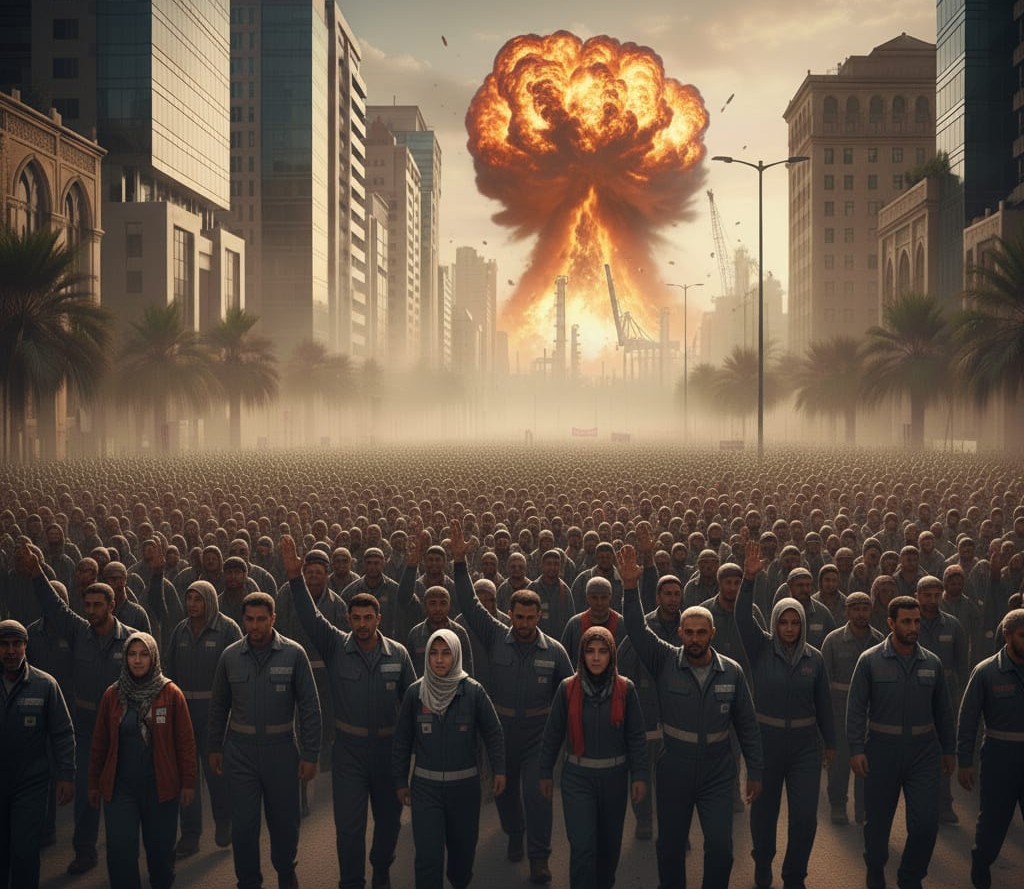
An urgent call from Arab trade unions to protect workers, defend democratic rights, and prevent the working classes from bearing the cost of geopolitical conflicts.
The growing military escalation involving Iran, the United States, and Israel is often presented in political and media discourse through the language of geopolitical balances, military strategies, and struggles for influence. Yet behind these narratives lies another reality that is rarely placed at the center of the discussion: the profound social consequences that wars impose on the lives of ordinary people.
From the perspective of the Arab trade union movement, the central question is not who will gain strategic advantages from this escalation, but rather who will ultimately pay its real price.
The history of the region, marked by decades of conflicts, has repeatedly demonstrated that wars may be declared by governments and fought by armies, but their economic and social costs ultimately fall on the shoulders of workers and their families through unemployment, rising prices, the destruction of livelihoods, displacement, and the erosion of rights and freedoms.
Today, the Arab region stands at a dangerous crossroads. The current military escalation is unfolding within a regional context already characterized by deep economic and social fragility. In many Arab countries, labor markets remain unable to absorb the growing number of young people entering the workforce each year. Millions of workers continue to live in precarious or informal employment conditions, without adequate social protection, stable contracts, or effective trade union rights.
At the same time, women continue to face structural barriers limiting their economic participation, while large segments of society struggle to maintain their purchasing power in the face of rising living costs.
Over the past decade, the region has been struck by a series of overlapping shocks: wars and armed conflicts, mass displacement, economic and financial crises, climate pressures, and austerity policies. Taken together, these factors have weakened social protection systems and placed enormous pressure on public services.
Within this fragile context, wars are not merely political events; they become multipliers of existing crises. Fluctuations in energy prices, disruptions in trade routes, and declining economic confidence quickly translate into rising prices, shrinking employment opportunities, and increased economic insecurity for working families. When the costs of food, transportation, and housing rise faster than wages, workers are the first to feel the pressure and the hardest hit.
A Region Already Burdened by Economic and Social Pressures
These risks are further compounded by the political context in the region. The Arab world continues to face a clear democratic deficit and increasing restrictions on civic space. In many countries, civil society organizations and trade unions operate within restrictive legal frameworks that limit freedom of association, constrain collective bargaining, and impose restrictions on the right to strike.
During periods of geopolitical tension or military escalation, these constraints often intensify. Some governments invoke national security or the need to preserve stability as justification for exceptional measures that may further restrict public freedoms and reduce the space available for trade union action.
In this context, the Arab Trade Union Confederation (ATUC) expresses its deep concern that political instability and military tensions could lead to the misuse of emergency situations to impose exceptional legislation or measures that undermine trade union and labour rights. Past experiences in several countries of the region have shown that security crises are frequently used as a pretext to adopt laws or policies that restrict freedom of trade union organization, impose additional limits on the right to strike, or allow unilateral decisions affecting wages and working conditions without genuine social dialogue.
The ATUC is particularly concerned that, under the pretext of defence laws, emergency legislation, or national security requirements, discriminatory policies or legislation could be introduced that undermine workers’ rights, weaken independent trade unions, and marginalize mechanisms of social dialogue. Protecting security and stability must never be used as a justification for undermining fundamental labour rights or restricting trade union freedoms, which form an integral part of international labour standards.
In this regard, the Arab Trade Union Confederation recalls that freedom of association and the right to collective bargaining are fundamental rights enshrined in the conventions of the International Labour Organization, particularly Conventions No. 87 and No. 98, and that these rights must be respected even during times of crisis and emergency.
The ATUC further emphasizes that any exceptional measures linked to states of emergency must remain temporary, clearly defined, subject to democratic oversight, and adopted in consultation with workers’ representatives through genuine social dialogue to ensure that fundamental labour rights are not undermined.
From the perspective of workers, the shrinking of democratic space during times of crisis has direct consequences on people’s lives. When social dialogue is marginalized and trade unions are excluded from decision-making processes, economic policies are more likely to be shaped in ways that shift the cost of crises onto workers through wage freezes, subsidy cuts, or increasing labour market precarity.
Migrant Workers on the Front Line of the Crisis
Among the groups most exposed to risk in this context are migrant workers, who represent a fundamental pillar of many labour markets in the region, particularly in Gulf countries.
Millions of migrant workers from Asia, Africa, and the Arab region itself contribute daily to building infrastructure, maintaining service and logistics networks, and sustaining economic life in cities. Their contributions extend across construction, domestic work, transportation, oil services, hospitality, and other vital sectors.
Despite this essential contribution to economic development, many migrant workers remain subject to labour systems that restrict their freedom of movement and limit their ability to access independent trade union representation.
In times of crisis, these workers often find themselves on the front line of vulnerability. Their contracts may be terminated without compensation, their wages delayed or withheld, and they may face forced repatriation or difficulties accessing legal protection and emergency support.
Protecting these workers requires cross-border trade union solidarity between unions in destination countries and those in countries of origin to ensure that no worker is left without protection during moments of crisis.
Peace, Democracy, and Workers’ Rights: The Only Path to Stability
The trajectory of this conflict remains uncertain, but several possible scenarios may determine its impact on workers. A rapid diplomatic de-escalation could limit the immediate economic shock, although inflationary pressures and labour market instability may persist. A prolonged period of tension could lead to recurring economic volatility, declining investment, and increasing pressure on public finances. In the worst case scenario, the conflict could expand to affect energy infrastructure, regional trade routes, and labour mobility, with severe consequences for employment opportunities and living standards.
In the face of these risks, the Arab trade union movement believes that defending peace cannot be separated from defending social justice. Genuine stability cannot be built on repression, inequality, or economic insecurity.
The dignity of workers, the protection of labour rights, and the strengthening of democratic participation are not secondary concerns they are essential pillars of any sustainable peace.
From this standpoint, the Arab Trade Union Confederation calls on governments, international institutions, and the global trade union movement to recognize a simple but urgent reality:
Workers must not once again become the silent victims of geopolitical conflicts.
The future of the region does not depend only on the absence of war, but on the presence of justice, dignity, and decent work for all workers.

 English
  Arabic