
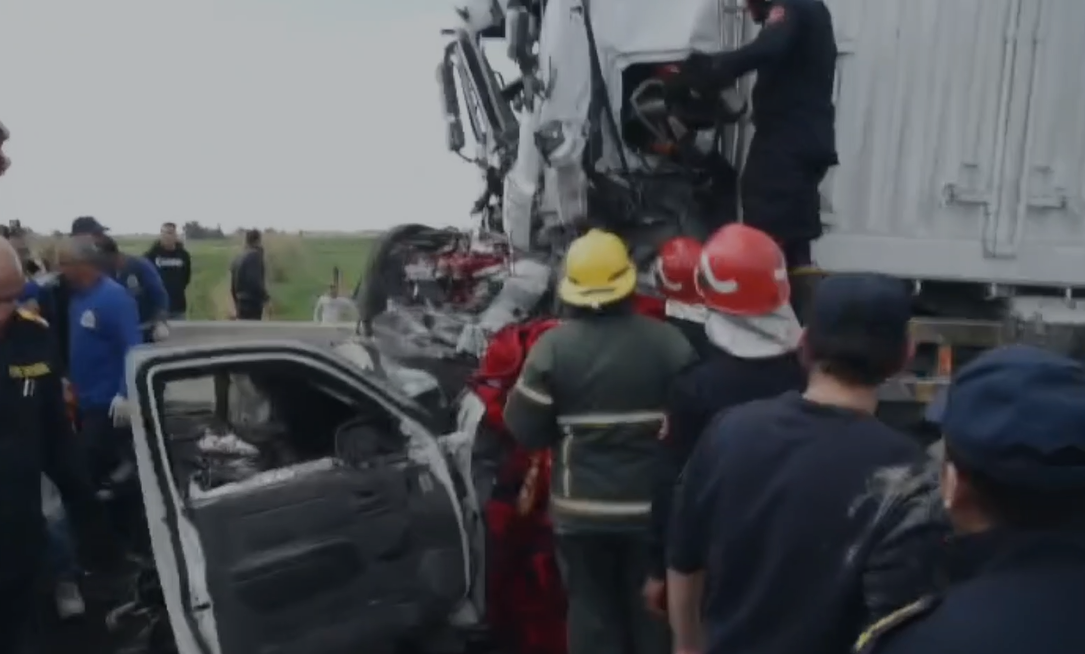
On the first day of Ramadan, a time that should be marked by mercy and tranquility, the road south of Port Said became the scene of yet another tragedy of precarious work. Sixteen day laborers who had left before dawn in search of their daily bread returned to their villages as victims of a deadly road. A heavy truck plowed into a pickup vehicle that was carrying them in its open metal cargo bed without seats, without seatbelts, without the most basic elements of human dignity that should safeguard the lives of those whose sweat keeps the wheels of production turning.
This is not an isolated disaster. It is another link in a bloody chain of systematic negligence, where inhumane means of transportation are turned into moving coffins, and workers are left facing two brutal choices: risk their lives, or lose a day’s wage they cannot afford to forfeit.
“They were standing next to each other in the back of the truck, no protection, not even a cover,” said the wife of one of the victims, her voice trembling. “He told me he’d be back before sunset so we could break our fast together… he came back in a shroud.” Her words are not only an emotional testimony, but a clear indictment of a reality in which the journey to work has become a daily hazard. Another worker explained: “We ride in that pickup every day. We know it’s dangerous, but there’s no alternative. If we refuse, they’ll bring others.” Caught between need and fear, workers are pushed to the edge of permanent risk.
From the perspective of International Labour Organization standards, the right to a safe and healthy working environment is a fundamental, non-negotiable right. This right does not end at the gates of the factory or farm; it extends to all aspects related to the organization of work, including transportation to and from the workplace when it is arranged by the employer. Occupational Safety and Health Convention No. 155 and its Promotional Framework Convention No. 187 place responsibility on both the state and employers to assess risks, take preventive measures, and ensure safe, standards compliant transportation.
Does transporting workers in the open bed of a truck, without proper seating or protection, comply with these standards? The answer is unequivocal. It represents a double violation: a breach of the employer’s duty of care and an affront to the dignity of the working person. When transportation is organized in this way, the road effectively becomes an extension of the workplace, and any accident occurring under such circumstances must be treated as a work-related injury or fatality, with all the legal accountability and compensation that this entails.
Egypt has ratified a number of ILO conventions and has incorporated occupational safety and health provisions into its legislation. Yet the gap between law and practice remains wide, particularly in sectors reliant on day labor and agricultural workers, where written contracts are often absent, labor inspection is weak, and complaint mechanisms are marginalized. The repeated recurrence of such tragedies reveals that the problem is not merely a traffic accident it is a fragile enforcement system and a persistent tolerance of transportation conditions unfit for human beings.
Dignity is not a legislative luxury. It is a prerequisite for any development that claims seriousness. One cannot speak of investment or growth while lives are lost on the roads because the cost of providing safe transportation is deemed higher than the value of a worker’s life. Shifting the burden of risk entirely onto workers in the name of necessity or competitiveness is a logic that undermines social stability before it threatens justice.
The Arab Trade Union Confederation expresses its full solidarity with the families of the victims and affirms that the time for mere condolences has passed. What is required is clear accountability for all who permitted or turned a blind eye to the continued transportation of workers in vehicles not designed for human passengers, strengthened preventive inspection, binding obligations on employers to provide safe transportation, and formal recognition of such incidents as work-related deaths, with all corresponding rights and compensation.
Sixteen workers were lost on the first day of Ramadan. Behind every name is a household that has lost its breadwinner, and a child waiting for a return that will never come. The road to daily bread will remain a road to death as long as the value of a worker’s life is measured at less than the cost of prevention. In Egypt, as everywhere, the right to life and safety must prevail over any discourse on productivity or profit. Development that does not protect its workers is not development it is a gamble with the lives of the poor.


 English
  Arabic