
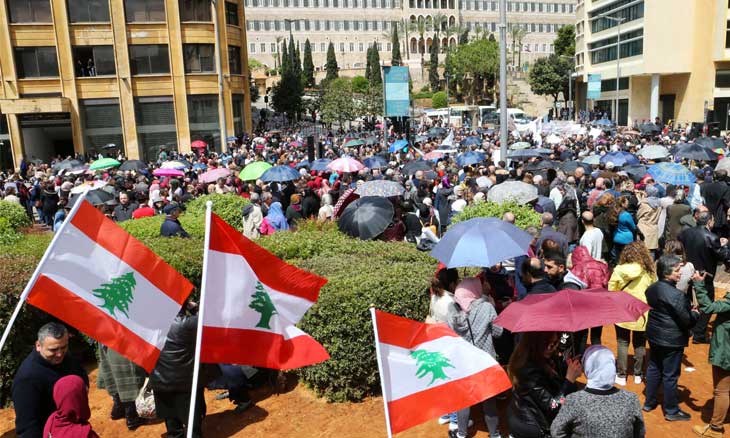
In Lebanon, collapse does not begin when public administrations close their doors, but when workers continue to report to work without the ability to survive. The morning of Tuesday, 27 January 2026 was not so much an exceptional event as it was a delayed collective acknowledgment: the Lebanese state can no longer function under the same rules that governed it before the collapse. That morning, judges halted their work, public schools closed, and public administrations came to a standstill. The strike was not directed against society; it was a cry from within it.
This investigation does not address the strike as a passing incident, but as a defining marker in the course of a prolonged crisis one in which the state has shifted from being a guarantor of rights to becoming a burden on its own workers, and from an employer to an entity that constantly demands sacrifice without offering social or economic return.
Since 2019, Lebanon has been experiencing one of the most severe compounded crises in its modern history: an unprecedented monetary collapse, hyperinflation, the disintegration of social protection systems, and a sharp decline in the state’s capacity to provide even the most basic services. Yet amid this catastrophic landscape, one fundamental question has long been postponed: how do public sector workers themselves live?
For years, public sector wages were treated as a technical detail that could be deferred. Temporary allowances, ad hoc assistance, and seasonal incentives were introduced, while the basic salary remained frozen detached from the cost of living and divorced from any vision of social justice or sustainability. In this way, the public worker was transformed into someone who works without security, earns an income insufficient for a minimum standard of living, and is nonetheless expected to preserve the continuity of the state.
It was within this context that the discussion of the 2026 budget took place. For the authorities, it was a fiscal milestone. For workers, it was a final test: either a genuine correction of the wage trajectory, or an implicit declaration of the end of the social contract.
The Judges’ Club of Lebanon did not resort to a warning work stoppage for political or corporatist reasons, but in response to a professional reality that had become unbearable. Judges unable to secure their basic needs, courthouses lacking operational necessities, and a system of justice endangered by the systematic impoverishment of those meant to safeguard it. When judges stated that the work stoppage was a constitutional right, they were not defending a privilege, but the very possibility of justice functioning at all.
In public education, the picture was even harsher. Teachers who had maintained a minimum level of educational continuity throughout the years of collapse once again found themselves excluded from decision-making calculations. Their strike was not a purely financial demand, but a defence of public schooling as a social right. When a teacher closes the classroom door, they are not merely bargaining over wages; they are declaring that education cannot be sustained through the perpetual erosion of the dignity of those who provide it.
As for public administration employees, they are the invisible backbone of the state. Those who manage transactions, social security, records, and payrolls have lived for years on the margins of public attention. Their organised mobilisation and carefully calibrated escalation schedule revealed that what is taking place is not chaotic demands, but a form of trade union consciousness an understanding that the state is not run by rhetoric, but by workers who are able to endure.
The paralysis that struck public services during the days of the strike was not surprising. What it exposed, however, was a deeper truth: the state was already paralysed, and the strike merely brought the dysfunction to the surface. Delayed justice, fragmented education, and sluggish administration are all symptoms that predated the strike by years. The only new element was that workers decided to stop masking this breakdown with their own bodies.
From a broader Arab trade union perspective, what is happening in Lebanon is not an isolated local case. It is a stark illustration of what occurs when economic crises are managed at the expense of workers, and when undeclared austerity policies are imposed through wage erosion rather than transparent decisions. It shows how an economic collapse can turn into a rights crisis, and then into a crisis of the state itself.
The danger in the Lebanese moment lies not only in the possibility of escalation or retreat, but in whether the authorities will absorb the lesson. Any approach based on temporary allowances or wage increases that are not financed in a socially just manner will merely postpone a larger explosion. And any increase financed through inflation will reproduce the same injustice in new forms.
What Lebanese workers are demanding today is not an exception to the Arab or global context. It is the very core of what the trade union movement defends: a living wage, social protection, and recognition of the worker’s social role. These are not sectoral demands, but fundamental conditions for social and political stability.


 English
  Arabic