
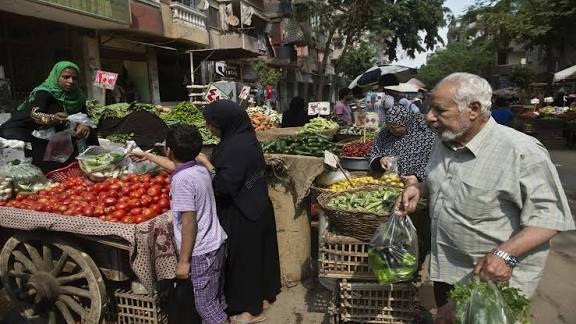
Egypt has raised its minimum wage repeatedly as inflation has battered household incomes. But a growing gap between public- and private-sector pay exposes a deeper problem: wages are still largely something decided for workers, rather than negotiated with them.
On 1 July 2026, millions of employees working for the Egyptian state saw their minimum monthly wage rise to 8,000 Egyptian pounds.
For millions working in the private sector, July began differently. Their statutory minimum remained 7,000 pounds, the level set by Egypt’s National Council for Wages in February 2025 and introduced the following month.
On paper, the difference is 1,000 pounds.
In reality, the argument is about considerably more.
It is about how wages are determined in a country where working families have endured years of inflation and repeated currency devaluations. It is about whether statutory wage increases can keep pace with the actual cost of food, housing, transport and other essentials. It is about the gap between legal entitlement and enforcement in workplaces.
Above all, it raises a more fundamental question: how much influence do Egyptian workers themselves have over the price of their labour?
That question matters because the Egyptian wage crisis is not simply about whether the private-sector minimum should rise from 7,000 pounds to 8,000 or 8,500.
It is about whether a country of more than 100 million people can build a wage-setting system in which workers are participants rather than spectators.
The same supermarket, two minimum wages
When the National Council for Wages raised the private-sector minimum from 6,000 to 7,000 pounds a month from March 2025, the government presented the decision as part of its effort to respond to economic pressures and protect workers’ purchasing power.
There was good reason to do so.
Egyptian households had been through an extraordinary cost-of-living shock. Successive rounds of inflation, currency depreciation and increases in the price of essentials had dramatically weakened the real value of wages.
The increase to 7,000 pounds was therefore significant.
But then the government announced that the minimum for state employees would rise to 8,000 pounds from July 2026.
Private-sector workers were left waiting for another meeting of the National Council for Wages.
By early August, no final date had been publicly confirmed for a meeting that would settle the next private-sector increase, although figures of between 8,000 and 8,500 pounds have circulated in Egyptian reporting and discussion around the council.
It would be a mistake to turn this into a contest between public-sector and private-sector workers.
A government employee and a factory worker buy bread in the same market.
They pay the same transport fares.
Their children need the same medicines.
Their landlords do not charge different rents according to whether their salary comes from the state or a private company.
Inflation does not ask who employs you before raising the price.
That is why maintaining two different wage floors for extended periods becomes increasingly difficult to justify socially.
If the state concludes that 7,000 pounds is no longer an adequate minimum for its own employees, the worker in a factory, hotel, supermarket or services company is entitled to ask a straightforward question: why should it still be adequate for me?
Egypt has raised the minimum wage dramatically. That matters
There is another side to this story, and it should not be ignored.
Egypt has made substantial progress in establishing and repeatedly increasing a mandatory minimum wage for private-sector workers.
In January 2022, the private-sector minimum stood at 2,400 pounds a month. It rose in successive stages to 2,700, 3,000, 3,500, 6,000 and finally 7,000 pounds in March 2025.
Nominally, that represents an increase of almost 192% in just over three years.
That is not a minor policy intervention.
Nor should trade unions pretend otherwise a statutory floor matters, particularly in an economy where the bargaining power of individual workers can be extremely weak.
The labour ministry also stressed when the latest increase was introduced that the 7,000-pound floor was mandatory for private-sector establishments, moving away from the broad exemptions that complicated earlier phases of minimum-wage implementation.
These are important advances.
But the trouble with wages is that workers do not eat percentages.
They buy food.They pay rent.They take buses and trains.They pay electricity bills, school costs and medical expenses.
And what matters in those transactions is not the nominal number printed on a wage decree, but what that wage can actually buy.
What does 7,000 pounds buy?
This is the central weakness in a debate conducted almost entirely in nominal figures.
A wage can rise substantially on paper while its purchasing power barely improves or even declines if prices and the currency move against it.
Egypt offers a particularly stark example.
The pound has lost a large share of its value over the past several years, while annual inflation reached extremely high levels during the economic crisis. Even after inflation began to moderate, households were left facing a permanently higher price level.
This distinction matters.
Falling inflation does not mean prices are falling.
It means they are rising more slowly.
For workers, therefore, the relevant question is not whether inflation is lower today than it was at its peak.
It is how much of the purchasing power lost during the crisis has actually been restored.
That is why minimum-wage policy cannot become an endless race in which prices move first and wages follow months later.
If the statutory wage is adjusted only after workers have already absorbed a major loss in purchasing power, the wage-setting mechanism is permanently reactive.
Workers are always catching up.
And often they never quite do.
A minimum wage is not a living-wage policy
There is a further distinction that matters internationally.
A statutory minimum wage is a floor.
It is not, by itself, a comprehensive wage policy.
Nor does the existence of a legal minimum automatically mean that every full-time worker earns enough to support a household at an acceptable standard of living.
The real policy question is therefore larger than whether the next figure should be 8,000 or 8,500 pounds.
It is: what methodology should Egypt use to decide what the minimum wage ought to be?
A credible system should be regular and predictable. Workers and businesses should know when the wage will be reviewed and which indicators will inform the decision.
Inflation clearly matters.
So does the cost of essential goods and services.
But productivity, economic growth, employment, the financial position of enterprises and the broader distribution of income should also enter the equation.
This is precisely where the International Labour Organization’s concept of wage-setting through social dialogue becomes important.
The wage should not be treated as a charitable concession by government or employer.
It is the economic return for labour – and one of the principal mechanisms through which the gains of economic activity are distributed.
But businesses are under pressure too
A serious labour argument also has to acknowledge the other side of the equation.
Egypt’s private sector is not a single economic actor.
There are large corporations with considerable revenues and market power. There are medium-sized companies operating on tight margins. And there are thousands of small enterprises struggling with financing costs, energy prices, imported inputs, exchange-rate volatility and weak consumer demand.
An abrupt wage increase can affect these businesses very differently.
Ignoring that reality would be poor labour policy.
A minimum wage that causes a vulnerable small business to close does not protect the worker whose job disappears with it.
But the reverse argument is equally important.
Business sustainability cannot be built indefinitely on the erosion of workers’ real wages.
If an economic model remains competitive only because full-time employees are paid less than they need to meet basic living costs, then the country does not merely have a wage problem.
It has a problem with productivity, value creation and the distribution of economic gains.
The answer is therefore not to choose between workers and viable businesses.
It is to build a wage policy that raises productivity and wages together – and provides targeted support where genuinely vulnerable enterprises need help adjusting.
Egypt has a wages council. But where is wage bargaining?
Egypt’s National Council for Wages was designed to create an institutional forum for one of the most sensitive questions in any labour market.
In principle, this is progress.
It is preferable to having millions of individual workers negotiate alone against employers with far greater bargaining power.
But a tripartite institution is only as strong as the representation inside it.
Its legitimacy depends on how regularly it meets, the quality and transparency of the economic evidence placed before it, and whether government, employer and worker representatives are able to negotiate as meaningful partners.
This is where Egypt’s minimum-wage debate collides with another, more politically sensitive issue: freedom of association.
A country cannot build strong wage bargaining with weak worker representation.
If social dialogue is to mean more than consultation, workers need organisations capable of collecting their demands, representing them independently, negotiating with employers and government, and – when necessary – disagreeing with both.
Social dialogue cannot function at full strength when one side of the table is structurally weaker than the others.
Egypt’s wage crisis is also a crisis of voice
Egypt’s Trade Union Organisations Law No 213 of 2017, and subsequent amendments, were supposed to establish a new legal framework for trade union organisation and pluralism.
Yet freedom of association has remained the subject of persistent concern among international labour bodies and trade union organisations.
Questions have continued over the practical ability of independent unions to register and operate, the conditions governing trade union organisations, and the extent to which workers can organise independently in practice rather than simply in law.
This might sound like a separate political or legal argument.
It is not.
It is directly connected to the 7,000-pound wage.
When collective bargaining is weak, the statutory minimum set by government or a national wages council becomes the primary – and sometimes almost the only – line of wage protection for large numbers of workers.
In a labour market with strong collective bargaining, the minimum wage performs a different function.
It is the floor, not the standard wage.
Above it sit collective agreements negotiated by unions and employers according to the conditions of particular industries, occupations and companies: productivity, profitability, skills, working time and the economic value workers create.
That is the difference between having a minimum-wage policy and having a wage policy.
The first prevents pay from falling below a legal threshold.
The second requires collective bargaining, worker organisation, credible economic information and the ability of workers to negotiate for a fairer share of what they produce.
The worker who waits
Without those institutions, millions of workers are placed in a strangely passive position.
They wait.
They wait for the government to announce an increase.
They wait for the National Council for Wages to meet.
They wait for the council to decide the number.
They wait for implementation instructions.
And in some workplaces, they wait to discover whether the employer will comply.
The worker is present everywhere in the economy – producing, selling, transporting, building, cleaning, serving and caring – but can remain remarkably absent from the process that determines what that work is worth.
That is the deeper democratic deficit behind Egypt’s wage debate.
A new labour law – and an old test
Egypt’s new Labour Law No 14 of 2025 represents another important attempt to modernise the legal architecture governing employment.
It contains significant provisions relating to employment protection, rights and emerging forms of work.
But labour legislation is not ultimately tested in the official gazette.
It is tested on the factory floor.
Does the worker know what the law guarantees?
Can she claim those rights without fearing dismissal?
Is there a union capable of defending her?
Does labour inspection have sufficient reach and resources?
If an employer pays less than the legal minimum, can the worker obtain an effective remedy quickly enough for it to matter?
These questions become particularly important in economies with large informal and precarious labour markets.
A worker without a stable contract, meaningful social protection or bargaining power does not become secure merely because parliament has passed a better law.
The success of the next minimum-wage increase should therefore not be measured by how many companies receive the decree.
It should be measured by how many workers actually receive the money.
Trade union freedom is an economic institution
Egypt’s experience also illustrates why freedom of association should not be treated as an abstract political luxury disconnected from economic policy.
It has direct economic consequences.
Workers who can organise can bargain.
Workers who can bargain have a better chance of securing wages that reflect their skills, productivity and the economic conditions of their sector.
Strong unions can also take responsibility for agreements before their members, help resolve workplace disputes before they escalate, and give employers a representative counterpart with whom credible compromises can be reached.
This is why independent worker organisation should not automatically be viewed as a source of instability.
In a functioning system of social dialogue, strong worker representation can actually make labour relations more predictable.
Serious investors need clear rules.
Workers need enforceable rights.
And governments need institutions capable of converting conflicts of economic interest into negotiation.
Weakening worker representation may produce silence.
But silence is not the same thing as stability.
The conflict between capital and labour does not disappear because the institutions capable of expressing it become weaker.
It simply loses one of the mechanisms through which it could have been managed.
The informal economy changes everything
There is another complication that makes the Egyptian debate even more urgent: a large share of employment exists beyond the reach of standard formal labour relations.
For these workers, the debate over whether the statutory minimum is 7,000, 8,000 or 8,500 pounds may be almost theoretical.
A legal wage floor protects only those whom the state can effectively bring within its reach.
That makes formalisation, labour inspection, social insurance and accessible complaints mechanisms inseparable from wage policy.
If the law says 8,000 pounds but a worker in an informal workshop receives substantially less, has no written contract and fears dismissal if he complains, the statutory figure offers little immediate protection.
This is why enforcement is not the administrative stage that follows wage policy.
It is part of wage policy itself.
This is not really about 1,000 pounds
The next meeting of the National Council for Wages should therefore not become an exercise in adding another 1,000 pounds to the existing number and then closing the file until the next cost-of-living shock.
Egypt needs a larger conversation.
It needs a transparent and predictable mechanism for reviewing the minimum wage, based on published economic and social indicators.
It needs enforcement capable of reaching workers in small establishments and sectors where compliance is hardest to monitor.
It needs a strategy for bringing informal workers progressively within labour and social-protection systems.
It needs policies that help viable small and medium-sized businesses absorb higher labour costs through productivity, financing and technological upgrading rather than through permanently suppressed wages.
But above all, it needs stronger collective bargaining and greater space for genuine worker representation.
Because wages should be the product of dialogue.
Dialogue requires representation.
And representation requires freedom of association.
Remove one link from that chain and social dialogue becomes structurally unbalanced.
The question Egypt cannot solve with another decree
Raising the public-sector minimum to 8,000 pounds has put pressure on the National Council for Wages to revisit private-sector pay.
That review should not be postponed indefinitely.
But closing the 1,000-pound gap between public and private workers will not solve the deeper problem.
Even if the private-sector minimum becomes 8,000 or 8,500 pounds tomorrow, Egypt will face the same debate again if wage-setting continues to move only after prices have already inflicted another loss on household purchasing power.
What Egypt needs is not simply another minimum wage.
It needs a wage policy.
One that treats wages as part of social justice rather than merely as a cost of production.
One that recognises the legitimate constraints facing enterprises without asking workers to absorb those constraints permanently through declining real incomes.
One that links wage development to purchasing power and productivity.
One that makes the statutory minimum an enforceable floor while allowing collective bargaining to build above it.
And one that gives workers – and the organisations they freely choose – a meaningful role in determining the economic value of their work.
After the National Council for Wages eventually meets, public attention will inevitably focus on one number.
Will the private-sector minimum be 8,000 pounds?
8,500?
Something else?
But Egypt’s more important questions cannot be answered with a number.
Can a person working full time live with dignity on what they earn?
And does that worker have a genuine voice when the value of their labour is decided?
Unless Egypt addresses both questions together, the country may continue raising its statutory minimum every year while leaving the underlying wage crisis intact.
Because the real divide in Egypt is not simply between 7,000 and 8,000 pounds.
It is between an economy in which wages are periodically given to workers, and one in which wages can genuinely be negotiated by them.
 English
  Arabic