
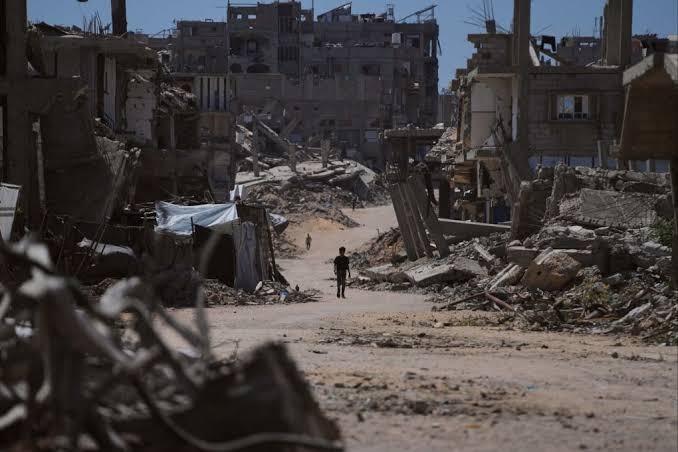
After more than one thousand days since the outbreak of the war, the world has become accustomed to reading the Palestinian catastrophe in the language of direct losses: those killed and wounded, the displaced, destroyed homes, schools and hospitals taken out of service, and roads and water and electricity networks requiring almost complete reconstruction. Yet beneath this rubble lies another catastrophe, less visible in the images, but one that will be among the most decisive factors determining the future of Palestinians after the war: hundreds of thousands of workers who have lost their jobs and incomes, and an economy that has lost not only production, but also a large part of the places where production used to take place.
From unemployment approaching 85% in Gaza to hundreds of thousands of workers without income, from the collapse of Palestinian employment inside Israel to the public-sector salary crisis in the West Bank, the war is no longer merely destroying jobs; it is reshaping the relationship between Palestinians and work and income. As estimates of recovery and reconstruction rise to tens of billions of dollars, a trade-union question emerges that is no less important than the question of rebuilding homes and roads: who will rebuild the labour market, and where will Palestinian workers stand in the economy of the day after?
In Gaza, the worker has not merely lost his salary. He may have lost the factory where he worked, or the workshop, shop, restaurant, farm, transport vehicle, or the tools that were his source of livelihood. The small-business owner himself may have lost his capital, stock, workplace, and home at the same time. Between displacement, the destruction of infrastructure, the interruption of supply chains, and the contraction of markets and purchasing power, returning to work for hundreds of thousands has become far more complicated than finding a vacant job.
Therefore, the question that will face Gaza on the day after any stability will not only be: who will rebuild the homes, roads and hospitals?
There is another question that is no less important: who will restore the worker’s job? Work is not a social outcome that automatically follows reconstruction. If Gaza is to regain a society and an economy capable of living, work itself must become one of the tools of reconstruction.
In an economy functioning normally, unemployment means that a person is looking for a job within a market that cannot absorb him. In Gaza, however, the worker may be present and ready to work, but the factory that employed him no longer exists. The skilled worker may possess the skill but not his tools. The farmer may be capable of producing but unable to reach his land, water, or market. The shop owner may reopen his doors, only to find himself facing a society that has lost a large part of its income and purchasing power.
What has collapsed, then, is not only the number of jobs, but parts of the system that produces jobs.
The scale of the shock was clear from the first months of the war, when the International Labour Organization estimated that more than 200,000 jobs had been lost in Gaza, representing more than two-thirds of the employment that existed before the war, with losses in labour income exceeding three million dollars per day at that stage.
But after more than one thousand days, the impact of unemployment becomes more dangerous than the original figure itself. A worker who remains outside the labour market for months and then years may lose part of his skills, professional relationships, and small capital, as well as his ability to purchase work tools, while new young people enter working age without finding the market that is supposed to give them their first professional experience.
Therefore, jobs will not automatically return when the war stops. Ending the war is a condition for economic recovery, but it is not an employment policy.
When the Workplace Is Destroyed… Who Restores the Job?
Reconstruction estimates reveal the scale of this dilemma. In February 2025, the World Bank, the United Nations and the European Union estimated recovery and reconstruction needs at around 53 billion dollars, before estimates rose with the continuation of destruction to higher levels, with more recent World Bank estimates placing needs at around 71.5 billion dollars. This figure is usually read from the perspective of housing and infrastructure, roads, water and energy. But from a workers’ perspective, the figure carries another meaning.
Early damage assessments showed that the trade and industry sectors were among the sectors most affected after housing, together accounting for around one-fifth of the estimated material damage at one stage of the assessment.
When a workshop, shop or factory is destroyed, the loss is not equal only to the cost of the building and machinery. There is a job that has disappeared, a family that has lost income, a supplier who has lost a customer, a transport worker who has lost activity, a municipality that has lost fees, and a local market that has lost part of its purchasing capacity.
Thus, the destruction of a job works in the same direction as unemployment: the worker who loses his income reduces his spending, the business that loses its customers reduces its workforce, and the new worker who loses his job reduces his spending in turn. In a small economy that was already under blockade, this circle can be devastating.
Therefore, rebuilding the building does not necessarily mean restoring the job.
We may rebuild a factory, but who will finance its working capital? Who will buy the raw materials? Who will restore electricity and water to it? And where is the market that will buy its production?
These are the questions that distinguish rebuilding the physical structure from rebuilding the economy.
550,000 Workers Without Income
In the spring of this year, the General Federation of Trade Unions of Palestine put a more direct figure on the social catastrophe, when it spoke of around 550,000 workers without income in Gaza and the West Bank.
Behind this figure are more than half a million stories of work, but socially it means much more than half a million people.
A Palestinian worker’s income does not concern the worker alone. In a society widely dependent on household income, several people may live on a single salary. When half a million workers lose their income, the shock extends to food, housing, education, health, debt and local consumption—in other words, to millions of people directly or indirectly.
Here, unemployment ceases to be an economic indicator and becomes a matter of social security. A family that has lost its source of income for two or three years cannot wait for GDP to return to growth. It needs social protection, cash assistance and services now, but at the same time it needs a way out of dependence on assistance.
And this is one of the most difficult questions Palestine will face after the war: how can hundreds of thousands of people move from relief to social protection, then from protection to training and work, and from emergency work to stable and decent employment?
The West Bank… The War That Entered the Labour Market Without Destroying the Cities
If physical destruction makes the labour-market tragedy in Gaza more visible, the West Bank is experiencing a different form of crisis.
There, the war has not destroyed factories and cities to the same extent, but it has entered the economy through other doors: checkpoints and restrictions on movement, declining commercial activity, falling investment and consumption, the financial crisis of the Palestinian Authority, settlement expansion, and, most importantly, the collapse of the ability of tens of thousands of workers to reach their jobs inside Israel.
Recent data and estimates indicate that unemployment in the West Bank reached around 28% during 2025, after reaching higher levels at the height of the shock, compared with around 13% before the war.
In other words, unemployment almost doubled.
This means that dividing the picture between “Gaza living through war” and “the West Bank living through an economic crisis” is no longer accurate. The entire Palestinian economy has been exposed to the shock of the war, although its forms and intensity differ.
The Jobs That Used to Cross the Checkpoint
One of the biggest sources of the shock was the interruption of the employment of tens of thousands of Palestinians inside Israel.
Before October 2023, this market was a major source of income for tens of thousands of families in the West Bank, and workers’ wages there were significantly higher than the average wages available within the Palestinian market.
World Bank estimates indicate that the initial shock led to the loss of around 148,000 jobs associated with Palestinian workers who had been commuting to the Israeli labour market, while the number of workers subsequently able to access that market remained far below pre-war levels.
But reading this figure as merely the loss of 148,000 salaries underestimates its real magnitude.
The worker would return with his income to Hebron, Nablus, Jenin, Tulkarm, Ramallah, or one of the hundreds of Palestinian villages and towns. He would buy from the local shop, use a taxi, repay a bank loan, build a house, pay university fees, visit a doctor, and buy construction materials.
It was income coming from outside the Palestinian economy, part of which was then spent back inside it.
When that income disappeared, the worker did not only lose his job; the local economy lost part of the liquidity that had been driving it.
The crisis also revealed a deeper vulnerability: an important part of Palestinian workers’ economic security was linked to their ability to access a labour market whose gates they did not control.
A job does not provide real security if a permit, checkpoint or political decision can separate a worker from it overnight.
A Worker Who Works… and a State That Cannot Pay His Full Salary
Then there is another, different crisis: the Palestinian who has not lost his job, but has lost the regularity of his salary.
The Palestinian Authority is suffering from a severe financial crisis, exacerbated by Israel’s continued withholding of a large part of clearance revenues, the taxes and customs duties it collects on behalf of the Authority. Recent reports indicate that the value of revenues withheld since 2023 has reached at least 2.5 billion dollars, while broader Palestinian estimates put the amount owed at higher levels.
This may appear to be a financial or political issue, but its daily impact is very simple: the employee performs his work, but the government cannot pay his full salary on time.
Women… The Work That Disappeared and the Work That Doubled
Within this catastrophe lies another loss that conventional unemployment figures cannot fully measure: what happened to women.
A woman who loses her job does not necessarily appear in unemployment statistics if she stops looking for work because of displacement, care responsibilities, lack of transportation, or the absence of a safe place to work. At the same time, the amount of unpaid work performed by women has doubled.
Caring for children, older people and the injured, securing water and food, and managing daily family life during displacement are all necessary forms of work for society’s survival, but they do not appear in GDP or on payrolls.
This means that war can push women in two opposite directions at the same time: out of paid employment and deeper into the unpaid care economy. Therefore, reconstruction must not become a male-dominated project that reduces employment to construction and rubble.
There are broad sectors in which women can be at the heart of recovery: health, education, social services, technology, administration, energy, entrepreneurship and small enterprises, as well as technical and engineering professions.
And if the world is going to inject tens of billions of dollars into the Palestinian economy, it is legitimate to ask from the outset: how much of this will reach women in the form of jobs, wages and businesses?
A Generation Entering a Labour Market That Does Not Exist
As for young people, the risks may last longer. An older worker who has lost his job at least has experience, a profession and a memory of the labour market. But a young person who was supposed to graduate and enter his first job during the years of war may lose the starting point itself.
The disruption of education and vocational training and universities, the destruction of institutions, and the absence of first training opportunities all mean that an entire Palestinian generation is at risk of reaching adulthood without the professional experience it needs.
These years cannot automatically be recovered when schools and universities reopen their doors.
Therefore, vocational training, retraining, apprenticeship programmes and linking young people to reconstruction projects must be a central part of any recovery plan.
If Palestine will need thousands of electricians, technicians, engineers, water and energy workers, construction workers, health workers and technology specialists, investment in these people must begin before the first major reconstruction contract arrives, not afterwards.
Small Signs of a Big Idea
Despite the scale of the catastrophe, there are experiences that have begun to prove that linking reconstruction with employment is indeed possible. During 2025, projects supported by the United Nations Development Programme contributed to employing around 2,819 local workers in service restoration and infrastructure repair works, while the programme, through various interventions, provided 5,947 emergency employment opportunities during the war in different fields.
The International Labour Organization also implements employment-intensive programmes that link infrastructure rehabilitation with the creation of income and employment opportunities for Palestinians. These figures are very modest compared with more than half a million workers without income. But their importance lies not in their size, but in the idea they demonstrate: the dollar spent on recovery can build a road and pay a wage at the same time. This idea must be transformed from a small project into a comprehensive philosophy for reconstruction.
71.5 Billion Dollars… The Question That Must Precede the Contracts
If current estimates place recovery and reconstruction needs at around 71.5 billion dollars, the Palestinian, Arab and international trade-union movement must ask a question before the competition for contracts begins:
How much of these billions will become wages and employment opportunities for Palestinians?
The question is not symbolic.
How many jobs will be created?
How many young people will be trained?
How many women will receive employment opportunities?
How many Palestinian factories will participate in supply chains?
How many small businesses will be restarted?
And how much of the money entering Gaza will circulate again within the Palestinian economy instead of leaving it through the chains of international contractors?
Where Are the Trade Unions in the “Day After”?
The General Federation of Trade Unions of Palestine, led by its Secretary-General Shaher Saad, has continued during the war to follow workers’ issues and complaints, including those of workers who used to work inside Israel. It has warned about the scale of unemployment and income loss and sought to keep the Palestinian labour issue present before the international trade-union movement.
But the current crisis is larger than the capacity of any national federation to deal with it alone. Therefore, international trade-union solidarity must move from statements to policies. Solidarity today means defending Palestinian rights in international institutions, but it also means building programmes to support workers, contributing to training and rehabilitation, rebuilding trade-union capacities destroyed by the war, documenting violations, and supporting social-protection systems.
Most importantly, Palestinian trade unions must be present when discussions begin about the “day after”. It is unacceptable for governments, donors, financial institutions and contractors to sit down to determine the future of the Palestinian economy and then call workers’ representatives later to ask them for their opinion on working conditions.
The labour market cannot be designed without workers.
Reconstruction Must Become the Largest Palestinian Employment Programme
If Gaza is to witness one of the largest reconstruction projects in the world in the coming years, it could also witness the largest employment and training programme in modern Palestinian history.
Rebuilding homes requires construction workers, technicians and engineers.
Rebuilding electricity networks requires technicians.
Water and sewage systems require workers and engineers.
Hospitals require doctors, nurses and technicians.
Schools require teachers.
Removing rubble requires machinery operators, safety engineers and specialised workers.
And rebuilding the economy itself requires accountants, programmers, entrepreneurs, traders, farmers and skilled workers.
So why do we treat reconstruction and employment policy as two separate issues?
Every reconstruction contract can be an employment contract.
Every infrastructure project can include a training programme.
Every million dollars spent can be measured not only by the number of metres rebuilt, but also by the number of days of decent work it creates.
From Assistance to Wages
This may be the most difficult point in the transition from war to recovery.
During war, a person who has lost everything needs assistance. Food, shelter and cash assistance are not a poor substitute for work; they are conditions for survival when work becomes impossible.
But the mistake begins when the emergency situation becomes a permanent model of life.
There is a profound difference between a person receiving assistance to live and receiving a wage because he works, produces and decides how to use the fruits of his labour.
Assistance protects a person from falling.
Work restores his independence.
Therefore, there must be clear bridges: from relief to social protection, from protection to training, from training to employment, and from emergency employment to decent and sustainable work.
It Is Not Gaza Alone That Needs to Rebuild Work
Amid the expected discussion about billions for the reconstruction of Gaza, the West Bank must not disappear from the picture.
The West Bank also needs to rebuild its capacity to create jobs locally, so that tens of thousands of families do not return to dependence on a labour market that can be closed to them at any moment.
The Palestinian Authority also needs to restore its ability to pay public-sector workers in health, education and services regularly, because the collapse of public services will become an obstacle to any economic recovery.
Small and medium-sized enterprises, which are the backbone of Palestinian employment, also need financing, access to markets and protection from collapse.
The future of the Palestinian labour market cannot simply be a return to the situation that existed on 6 October 2023.
That situation was already fragile.
The aim must be for reconstruction to become an opportunity to reduce this fragility.
Who Will Restore the Worker’s Job?
After more than one thousand days, the world needs to change the way it measures Palestinian recovery.
It will not be enough to say how many homes have been rebuilt.
We must ask how many workers have returned to work.
It will not be enough to count the number of schools that have reopened.
We must know how many teachers can live on their salaries.
It will not be enough to count investments.
We must know how many decent jobs they have produced.
And we must know how many women have regained independent incomes, how many young people have received their first professional opportunity, how many small businesses have returned to production, and how many families have moved from assistance to stable income.
These are not marginal labour indicators.
They are indicators of whether society itself is recovering.
Palestine Does Not Need Reconstruction Alone
At the end of wars, financial institutions, donors, contractors and engineers arrive. Plans are drawn up, budgets are determined, and maps of new cities are designed.
But cities do not live on cement.
They live through the people who work in them.
Therefore, the greatest economic and social battle awaiting Palestine may not only be the collection of the tens of billions of dollars needed for reconstruction, but the transformation of hundreds of thousands of people from unemployed, displaced persons and recipients of assistance into workers, producers, farmers, teachers, doctors, engineers, technicians and business owners.
This is not only an economic issue.
It is an issue of dignity and rights.
Work is not merely a salary. It is economic independence, the ability to support a family, a place within society, and a sense that a person has a role in the future.
And when the world begins calculating the tens of billions needed to rebuild Palestine, the trade-union movement must add one figure to the calculation:
How many Palestinian jobs will we restore?
Because rebuilding Palestine without rebuilding work means rebuilding the place and leaving the human being waiting.
But reconstruction that makes the Palestinian worker a partner in building his country, protects his wage, safety and rights, invests in the skills of young people and women, supports local institutions, and places trade unions at the decision-making table is what can transform reconstruction from an engineering project into a project of social justice.
Palestine, after one thousand days, does not need only those who will rebuild what the war destroyed. It needs those who will return the worker’s tools to him, the farmer’s land to him, the teacher’s school to him, the health worker’s hospital to him, the woman’s right to work to her, and the young person’s first path into the labour market to him.
As for the answer to the question: who will restore the Palestinian worker’s job? It cannot be the donors alone, nor the government alone, nor the market alone.
It is a Palestinian, Arab and international responsibility, and it must be part of a new social contract in which workers and their unions are partners in shaping it, not merely beneficiaries of it.
Because money will rebuild many things in Palestine.
But the people who will truly rebuild Palestine are the people who will work in it.
They are the workers of Palestine.
 English
  Arabic