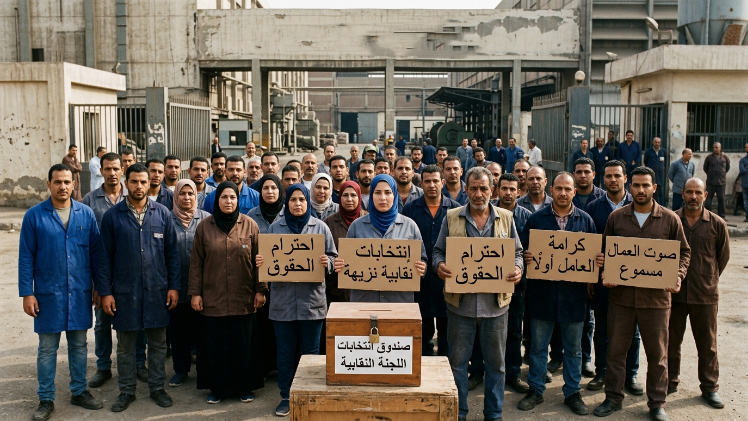
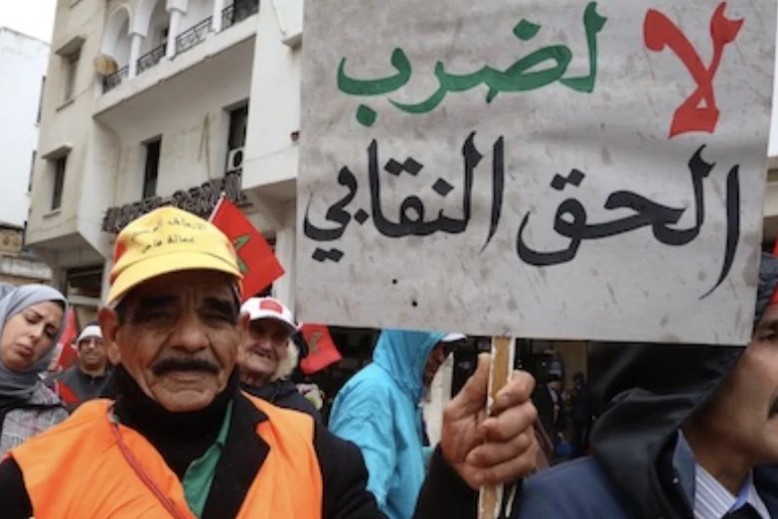
Every time trade union elections are postponed, it is not merely an administrative date that is delayed. What is effectively postponed is workers’ right to ask: Who represents us? Who speaks in our name? And who has the legitimacy to negotiate over our working conditions, wages, safety and dignity?
This is the core of the debate currently taking place in Egypt around the extension of the trade union term and the postponement of labour elections. The issue cannot be reduced to a legal amendment adding a few months or a year to the mandate of existing trade union councils, nor to technical justifications related to preparation or organisation. At its heart, it is a real test of the place of democracy within the world of work, and of the actual ability of workers, women and men, to freely choose, hold accountable and renew their representatives.
Trade union democracy is not a procedural detail within workers’ lives. It is one of the essential forms of social democracy. When it weakens inside workplaces, the effects are felt across society as a whole. Workers who cannot freely choose their representatives will not be able to effectively defend their wages, working conditions, occupational safety, or right to social protection. And trade unions whose electoral cycles are managed from above gradually lose their living connection with their worker base.
From this perspective, extending the trade union term in Egypt becomes an issue that goes beyond the legal text and raises a broader question: Is the law being used to guarantee freedom of association, or to manage the trade union space and control its political rhythm? Is the purpose of changing the duration of the term genuinely to strengthen the stability of trade union institutions, or to entrench existing power balances and postpone an electoral moment that could open the door to accountability and renewal?
Law No. 213 of 2017 on Trade Union Organisations and the Protection of the Right to Organise provides that the trade union term lasts four years. This provision was not introduced as a mere formal detail, but as a guarantee of periodicity and accountability. A time-bound electoral cycle is what prevents trade union representation from becoming permanent. It is what reminds every trade union leadership that its legitimacy is not eternal, but derives from the workers themselves.
For this reason, any extension of this term cannot be treated as a neutral matter. Formally, such an extension may become legal if it is adopted through a clear legislative amendment approved by parliament and published in accordance with proper procedures. But trade union legitimacy is broader than formal legality. The more important question is: What is the practical impact of this extension? Does it expand workers’ right to organise and choose? Or does it prolong the life of existing councils without addressing the restrictions that limit trade union pluralism and freedom of association?
Here lies the difference between law as a guarantee and law as an instrument of control. In the trade union sphere, it is not enough for a measure to be “legal” in formal terms. It must also be consistent with the substance of freedom of association and with workers’ right to organise themselves and choose their representatives without interference from public authorities, employers or any administrative structure that restricts their will.
This is precisely what international labour standards affirm, particularly ILO Convention No. 87 on Freedom of Association and Protection of the Right to Organise, and Convention No. 98 on the Right to Organise and Collective Bargaining. These standards do not view the trade union as an administrative institution, but as an independent democratic organisation created by workers to defend their interests. Therefore, the right to freely elect representatives is not a secondary element; it is one of the pillars of freedom of association.
In light of the principles of the ILO Committee on Freedom of Association, any intervention by the authorities in trade union elections, their timing or their conditions becomes problematic whenever it restricts workers’ right to choose their representatives. This concern does not disappear merely because a legislative text has been adopted, if the practical effect of that text is to obstruct trade union competition, freeze representation, or exclude independent workers’ organisations from effective participation.
For this reason, the debate in Egypt today is directly linked to the International Trade Union Confederation’s campaign on democracy. The campaign does not separate political democracy from social democracy. It starts from a simple truth: we cannot speak of democratic societies while workers are denied democracy in their workplaces. Where trade unions are weakened, society’s ability to resist inequality, austerity, exploitation, precarious work and violations of fundamental rights is weakened as well.
In Egypt, this debate does not arise in a vacuum. Over recent years, the trade union environment has witnessed repeated tensions around the recognition of independent unions, registration requirements, freedom of trade union activity and pluralism within workplaces. The independent trade union movement has been among the voices repeatedly warning that the problem lies not only in the date of elections, but also in the legal and administrative structure that determines who is recognised as a union and who is left outside the official space.
This is the core of the danger for the independent trade union movement. Elections, despite all restrictions, remain an important political and organisational moment. They are the moment when workers can raise the question of representation anew, test existing leaderships, bring forward new faces, and rebuild the relationship between the union and its base. Postponing this moment means postponing the possibility of change, particularly in an environment where independent unions already suffer from an imbalance of power.
As for legally recognised unions, the extension may appear, on the surface, to be a factor of stability. But it is a stability fraught with risks. A union that does not regularly renew its legitimacy may shift from being a tool of representation to becoming an administrative apparatus. A leadership that remains in place because of an extension rather than elections may gradually lose the trust of the worker base, even if it enjoys legal recognition. Administrative recognition alone is not enough to build genuine trade union legitimacy. Legitimacy is built from the base, through elections, accountability and the daily capacity to defend workers.
From the perspective of the Arab Trade Union Confederation, no genuine trade union reform can begin with the extension of mandates. Real reform begins with opening space for workers to freely choose their representatives, removing the legal and administrative restrictions that obstruct independent organising, and guaranteeing transparent elections free from interference by management, employers or public authorities. It also begins with recognising that the Egyptian labour market has changed: there are workers in the informal economy, young people in precarious forms of work, women facing multiple forms of discrimination, and workers in new sectors that traditional unions do not easily reach. These workers do not need trade union democracy to be postponed; they need it to be expanded.
Linking this debate to the ITUC campaign on democracy is not merely symbolic. Democracy in the workplace is the first line of defence against the dismantling of rights. When workers are organised, they are able to negotiate. When trade unions are independent, they are able to hold public policies to account. And when trade union elections are periodic and fair, workers’ representation becomes stronger and more legitimate.
Therefore, the question being raised in Egypt today should not only be: Is it legally permissible to extend the trade union term? Rather, it should be: Does this extension serve freedom of association? Does it strengthen workers’ right to choose their representatives? Does it open space for independent unions? Does it guarantee the participation of women, young people and workers in precarious sectors? And does it make the trade union movement more democratic and more capable of defending workers?
 English
  Arabic