
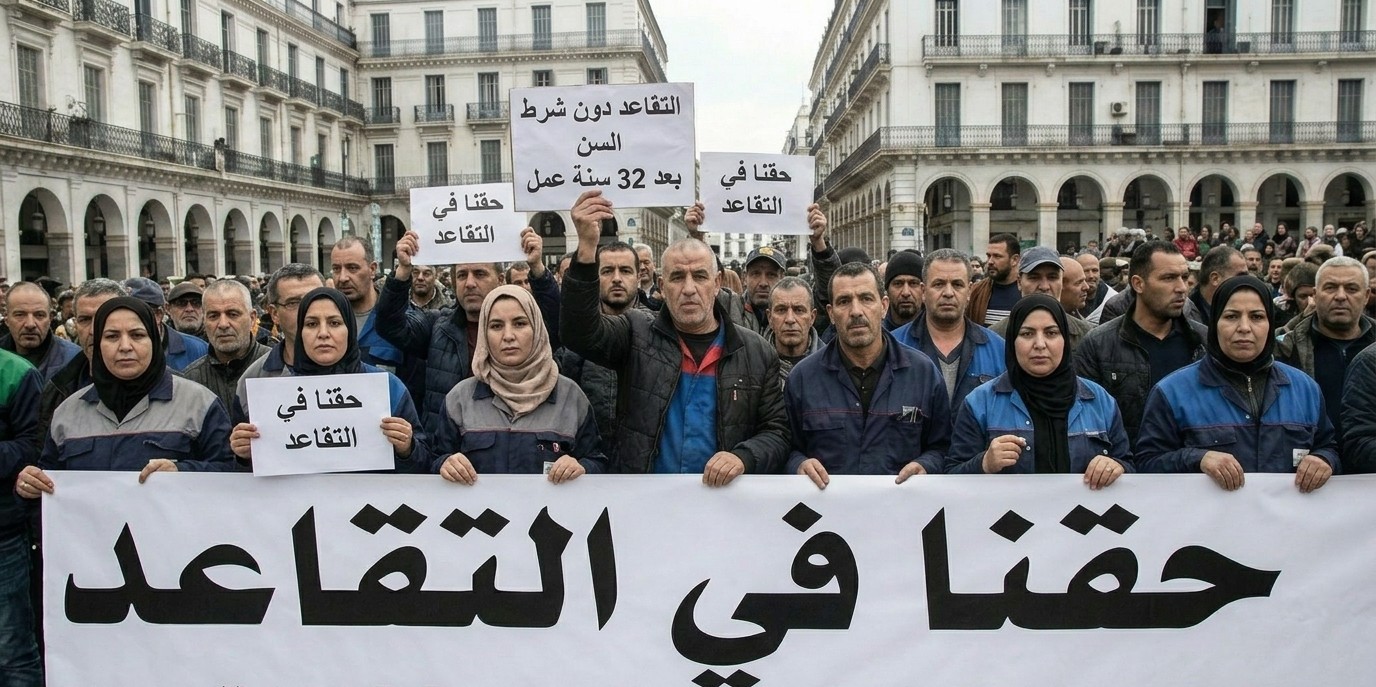
The issue of retirement after 32 years of service in Algeria has returned to the forefront of social debate, not merely as a sectoral or category-based demand, but as a broader question about the meaning of justice after decades of work. A worker who began their career early, paid contributions for many long years, and was worn down by working conditions is not only asking about the date on which they can leave employment. They are asking the state and society: what do more than thirty years of work mean? And is retirement a social right, or merely a financial equation inside a fund?
This is the heart of the current controversy. The government approaches the issue from the standpoint of the financial balance of the National Retirement Fund and the sustainability of the system. Trade unions and workers approach it from the standpoint of fairness, occupational exhaustion and the right to a dignified retirement after a long career contributing to the national economy. Between these two readings, retirement after 32 years of service stands as one of the most sensitive social files in Algeria.
Legally, the general rule in Algeria remains based on the statutory retirement age: 60 for men, with the possibility for working women, upon request, to retire at the age of 55, in addition to reductions linked to the number of children under specific conditions. This is what the National Retirement Fund explains in its presentation of the conditions for retirement at the legal age.
But the system was not always structured in this way. Algeria had, especially since the late 1990s, formulas for proportional retirement and retirement without an age condition, before these were reversed in later reforms, particularly through the 2016 law, which effectively abolished the previous pathways to retirement without an age condition and opened the possibility of continuing work until the age of 65. Documents from the National Economic, Social and Environmental Council have noted that Law No. 16-15 of 2016 amended Retirement Law No. 83-12 and repealed Ordinance No. 97-13, as part of an approach aimed at addressing financial imbalances in the retirement system.
Therefore, the demand for “32 years of service without an age condition” is not a new demand. It is a return to a social and legal memory that workers experienced and then lost. This explains its symbolic strength. When a worker today demands retirement after 32 years, they are not asking for an exceptional allowance; they are invoking a right that existed at a previous stage and arguing that its abolition shifted the cost of the fund’s crisis onto wage earners alone.
In March 2026, the government’s position was clear: the Minister of Labour stated that a return to retirement without an age condition, including for those who have completed 32 years of service, is “not on the table” or “impossible” under current circumstances, justifying this by the need to preserve the financial balance of retirement funds. This position summarises the logic of the state: the disagreement is not about the legitimacy of exhaustion, but about the fund’s capacity to absorb a broad wave of early retirements.
Yet the argument of financial balance, however strong, is not the whole answer. Financial imbalance alone does not explain who should pay the price. Should it be paid by the worker who has worked for 32 years? Or by the informal economy that does not declare workers? Or by companies that evade contributions? Or should the state assume responsibility through tax and social reform that broadens the funding base? Here, the debate moves from actuarial calculations to social policy.
Trade unions, foremost among them the General Union of Algerian Workers, tend to call for opening a debate on reforming the retirement system, while distinguishing between a general return to the 32-year formula and the need to address the situation of arduous occupations.
Independent unions, especially in education, health and the public service, are more forceful in defending the restoration of proportional retirement or retirement without an age condition. In these sectors, 32 years is not seen as an administrative figure, but as accumulated fatigue: overcrowded classrooms, psychological pressure, educational responsibility, shifts, exhausting health work and deteriorating working conditions. For these unions, the demand for early retirement becomes part of occupational health, not merely a financial privilege.
Parliament has also entered the debate. In March 2026, it was announced that a draft law had been submitted to establish retirement without an age condition after completing 32 years of work, bringing the issue back to the political forefront. But the existence of a draft law does not necessarily mean that it will become an enforceable right. The file clearly faces a cautious government position and the unresolved question of funding.
As for employers and economic partners, although their positions do not appear with the same intensity in the public debate, their logic often converges with that of the government on financial sustainability and the cost of contributions. Algeria’s retirement system is based on social contributions, part of which are borne by workers and employers. Specialist sources indicate that employee and employer contributions form a core basis for financing social security. Employers therefore usually fear any reform that would raise contributions or increase labour costs, while unions fear that this argument may become a pretext for freezing rights.
Here, international labour standards are useful for recalibrating the debate. The International Labour Organization does not impose a single retirement model on states, nor does it require them to establish retirement after 32 years of service. But it does set out general principles: the right to social security, adequacy of benefits, non-discrimination, sustainability and social dialogue. ILO Convention No. 102 on Social Security Minimum Standards considers old-age benefit one of the essential branches of social protection and sets a reference age that should not exceed 65, except under conditions linked to the capacity of older persons to work.
This means that the demand for retirement after 32 years is not, in itself, contrary to international labour standards. It can be consistent with them if formulated as an optional, regulated, funded and non-discriminatory right, especially for those who have worked for a long period or in arduous and exhausting occupations. But international standards do not provide a blank cheque for any unfunded system either. They link the right to social protection with sustainability, governance and dialogue.
The solution should not be a choice between total rejection and total restoration. There is a third path that is stronger and fairer: opening national negotiations on retirement reform, beginning with the recognition that 32 years of actual service is not an ordinary figure, and that those who have completed it should have additional rights. This could take the form of conditional optional retirement, higher valuation of years beyond 32 years of service, a special scheme for arduous occupations, or a reduction in the retirement age in specific sectors following an independent medical and occupational assessment.
The government has already moved partially in this direction. In 2025, a draft scheme for the education sector was presented, allowing the retirement age to be reduced by three years: 57 for men instead of 60, and 52 for women instead of 55, for certain categories of education workers. This proves that sectoral exceptions are legally and politically possible. But it also raises a legitimate question: why education only? What about health, transport, mines, energy, heavy industries and occupations involving high psychological and physical risks?
From a trade union perspective, the debate must move from the slogan “32 years for all or nothing” toward building a strong negotiating file. This file should include a national classification of arduous occupations, a transparent actuarial assessment of the cost of each scenario, serious action against undeclared work, an expansion of the contribution base, a review of exemptions that weaken the financing of social protection, and the involvement of trade unions in the management and oversight of the fund. Workers are not only asking to leave work; they are asking for the system to be fair and transparent.
What is needed today is genuine social dialogue that does not begin with rejection and does not end with slogans. A dialogue that recognises that the fund needs balance, but also that workers need dignity. A dialogue that says clearly: sustainability does not mean making people work until exhaustion, and justice does not mean bankrupting the fund.
 English
  Arabic